The end of lost
We were told later that when we hit the ground, it only made one sound—a single, dense thud representing two bodies being taken down simultaneously. I didn’t hear a noise when it happened. I was too shocked to find myself no longer upright. Only a second before, I had been straddling my bike, squinting through the rain as I looked forward down the road ahead of me. Now I was lying on a set of railroad tracks in an industrial area of downtown Baltimore, wearing a black trash bag like an oversized, awkward, and useless raincoat. I was soaking wet and miserable.
Before I tried to get up, first by rolling my back and then trying to get my left leg out from under my bike, I looked over to see that my twin sister, Erin, was also on the ground, in the same predicament. Instead of having pushed off from our standing positions, leading a group of twenty-five other riders, all exhausted and drenched, she too was horizontal, her shoes still in the cages attached to her pedals, her hands still on her handlebars, as though she was in motion. We were three days into a twelve-day charity ride up the East Coast, and I was ready to give up.
It wasn’t the first time that getting my bike tire stuck in tracks had caused me to go down suddenly—I lived in New Orleans for six months right after college, and it happened frequently on my commutes to and from work. I waited tables at a restaurant in the French Quarter and lived in Mid-City, so I crossed the streetcar tracks in the middle of Canal Street on my bike at least twice a day, once on the way to work, and then again on my way home when my shift ended. Crossing the tracks always made my heart race. No matter how often I did it, it made me nervous every time, as though the sight of the tracks tricked my brain into forgetting how to control my bike. I would look down so I could be sure I had my front tire turned at the right angle to avoid getting caught in the track, but often I would still come crashing down, my palms and knees scraping the concrete, my skin and blood left behind, my body sprawled out. During one particularly bad wreck, my bike kept going after I hit the ground, ghost-riding down Canal without me. I looked up, the wind knocked out of my chest, my bloody palms too soft to push my body up, my legs unable to chase my rusty old mountain bike through traffic. I watched it longingly as it slowly began to wobble, destined to fall without me there to pedal it, a danger to itself and to oncoming cars. I felt worse for my bike than my own body as I watched it come to a stop and fall over, defeated, no longer able to carry on.
Even though I was used to crashing, on that particularly gloomy day in Maryland, I felt more discouraged than ever that my mode of transportation was failing me. Moments earlier, Erin and I had stopped to look at the soggy map she carried in her hip pack so we could figure out how to navigate our fellow riders to the warehouse where we were staying that night. They were all depending on Erin—she had been the one to organize the trip. I tried to be helpful, but I was tired. It hadn’t stopped raining since we left northern Virginia that morning. It had been a long, exhausting day of dodging potholes filled with dirty rainwater, only to get splashed moments later by passing cars, which never seemed to give any of us enough room on the road, no matter how big the shoulder. I desperately wanted was to get out of my spandex shorts and to no longer feel my bike seat rubbing sore spots around my crotch. I didn’t want to feel the grip tape on my handlebars that I had clenched all day, white-knuckled, while I ground my teeth and ducked my eyes from the rain and the wind. We were less than half a mile away from a roof, and a dry floor where I could change my clothes and take off my wet shoes and throw away my trash bag outfit. Only half a mile from putting our bikes away for the evening and forgetting about how hard the day had been. Instead of pedaling towards our refuge, I was lying in gravel wondering what the hell I was doing on this bike ride in the first place.
Just as soon as Erin and I hit the ground, some of the other riders hopped off their bikes and came over to help us get up. I don’t remember whom exactly. It’s not because I was embarrassed that I didn’t pay attention to who slid my bike out from under me and who grabbed my arms to pull me to my feet. My hip and shoulder were more bruised than my ego from the fall, but I don’t recall who assisted me because I was too busy thinking about how pissed I was. Only a few days into our two-week trip, it didn’t make sense to me anymore why I was doing it. I had no money—I should have been working instead of bike riding and camping and sleeping on the floors of strangers’ homes along the East Coast. I wasn’t a necessary part of the trip. I didn’t have a special role or responsibility. I wasn’t in charge, and I didn’t help with planning. At this moment, I definitely felt like a burden.
About eight months earlier, in early winter of 2004, I had moved to New Orleans. It was before Hurricane Katrina. I went to a coffee shop by my house one day, and the barista, a girl named Brittany, whom I knew only a little, told me she was heading to New Orleans to get out of town for a while, or maybe forever. On impulse, I told her I would go with her. More than just accompany her to Louisiana, I also told her I would take us, in my car, and find us a place to stay. My close friend Anna was from Louisiana, and she could put me in touch with people she knew.
Leaving so suddenly seemed strange to my family, but it wasn’t for me. I had just graduated college in May and had no plans for the foreseeable future. After the excitement and freedom of the summer passed, my wait-and-see lifestyle didn’t seem as much fun anymore. The weather had turned cold, and daily bike rides through the city and weekend games of pick-up basketball were over for now. My friends were busy, and my sister was still in school. The days were short, and I didn’t have anything to fill them other than working my monotonous jobs. I was bored and growing more depressed by the day. It had only been six months, and already I needed an escape. I made a plan to leave before Christmas to drive to New Orleans and find a place to live, and then return to Virginia to spend the holidays at my parents’ house. Anna gave the number of a friend who lived in a warehouse with eight other people, and he agreed to meet me. If we got along well, then there was the possibility of being asked to move into an open room.
I almost didn’t get out of town at all that winter. One night, a few weeks before Brittany and I were supposed to drive south, my car was stolen while I was delivering Chinese food to an apartment complex across from one of the most expensive hotels in downtown Richmond. I’d just left the building and was walking back to my car when I saw it moving away from me and out of the parking lot. I stood for a minute and watched in disbelief, pondering over how my car could be moving without me in it. An hour later, I was getting a ride home from a city police officer. He told me that although the car was being reported stolen, it wouldn’t be a priority, and therefore not be on the “hot sheet,” since it wasn’t related to another crime. Stealing my car was too innocent a crime to matter, and it wasn’t likely it would be found. I appreciated his honesty, but still went home crushed and humiliated to have to tell my friends I might not be leaving town anymore.
The next afternoon, I received a call from my bank. A man had tried to cash a check he had supposedly received from me, and the teller thought it seemed suspicious. She informed me she had gone ahead and cashed the check for the “paint job” this man did for me, but then decided to call me to let me know she thought something about it was weird. The phone call upset me for two reasons. The first was that I had already called the bank the night before to tell them my car, my purse, my wallet, and my checkbook had all been stolen; she should have never given him money out of my account in the first place. But what I was more furious about was the fact that the bank where the guy cashed the check was only two blocks away from where he stole my car. He never left the crime scene!
As soon as I hung up the phone, I got on my bike and rode toward the hotel where I had last seen my car as it was driven away without me in it. Before I even got to the parking lot, I spotted my car, parallel parked on the street, neatly and legally, only five blocks away from where it had been the night before. I slammed on my brakes and jumped off my bike, throwing it down on the sidewalk. From the outside, the car looked fine, with no signs of damage. I tried the driver’s side door—unlocked. I sat down inside and looked around, my eyes shifting for clues that the thief had left. Everything looked normal. Down on the ground, near my feet, my keys sat on the floorboard. I picked them up and tried to start the car. Only the clicking noise of a dead battery came out of the ignition. I reached for the switch for the headlights, finding it on, the reason for the drained battery. Before I got out, I looked around a little closer. My bag was gone along with my CD books, but the car was fine, and I wondered if I really had seen a stranger driving away from me the night before, a shadow in the driver’s seat.
I got out of the car and walked into a hair salon, the closest business, and asked if I could use the phone. I called my friend Ward. He was the only person I knew that owned his own business—a local independent bookstore—and could possibly leave for a minute in the middle of the day to help me. He answered, and within ten minutes he was there to jump-start my car. From Ward’s phone, I called the officer who had given me a ride home less than 24 hours earlier, and told him I had found my car. He was stunned. I jokingly told him he could stop looking for it now that I found it, knowing full well there was no search underway. Less than an hour after I had gotten the call from my bank, it was over. I put my bike in my car and drove home. It all felt like a sign that I was making the right decision to get out of town. One week later, I left.
New Orleans was magical from the moment we arrived. We got along with everyone at the warehouse and were invited to stay for as long as we liked. I felt like we had scored so big. For 85 dollars a month, Brittany and I shared a room, making my rent only a little more than $40. I would be able to work less in Louisiana than I had been working in Virginia, giving me more free time to enjoy getting to know my new, insane, gorgeous home. My energy was renewed. Though it was January, it was not cold enough to keep us indoors, and there were so many new territories to explore – Uptown, Audubon, the Garden District, Tulane, the Bayou, and the West Bank.
The warehouse was a three-story former paper factory that had been converted into a living space many years before. Bedrooms had been created on the second floor with old wooden doors and scrap wood, salvaged from other old buildings or found discarded throughout the city. All of my roommates were lively, wildly different people who were incredibly welcoming and funny and willing to show me the tricks for living cheap and getting things for free in New Orleans. They showed me where live music was happening away from the tourists who wandered on and off Bourbon St. We played basketball together, all the girls and boys, at two in the morning, rode bikes to the river to drink whiskey, and had potlucks with our neighbors. From time to time, bands would play at the warehouse, and there was an endless rotating group of travelers coming in and out. The warehouse had a free library and a communal kitchen, and our roommate, Rob, DJed at local clubs and would get us in on nights when ladies drank for free. We would go out dancing until 4 a.m., spilling out into the street, still full of energy for our bike ride home.
It was in New Orleans that I learned to work on my bike for the first time. I had always been too intimidated to try it. I didn’t know any women who worked on bikes, and I never felt comfortable asking anyone to teach me. But at the warehouse there were always plenty of tools lying around in our large communal workspace. Essentially a long, enclosed driveway with two large sliding doors on either side, the space was mainly used for bike storage and collecting treasures—used Mardi Gras costumes and scrap metal. Old metal signs lined the walls. Stashed in among the other bikes, a two-seater decorated in blue felt waited patiently for its next trip around town. Attached to the front of it was a huge blue cat head. I would pick up friends from the bus station on that cat bike, its ears flopping in the breeze, the reaction to my mode of transportation always different. Old bike tubes filled plastic crates on the floor, and rotten tires hung from pegboards.
I used my free time to teach myself as much as I could about working on my own bike. I would loosen the bolts on my front and back wheels, pull them out of the dropouts, and use a tire wrench to remove the tire, pull the tube out, deflate the tube, and then inflate it just enough to put it back in the tube before returning the tire to the wheel. Sometimes I’d patch old tubes that were lying around just to make sure I knew exactly how to use the rubber patch and the glue properly, blowing gently on the tube so the glue would dry a little before placing the patch on top and then pressing it together with my palms for two or three minutes to ensure it was secure. I loved working on bikes and feeling confident in holding a wrench. It was so liberating for me to feel that I could hold my own around bicycles.
New Orleans was perfect for six months. Then that spring, Erin called me and told me she had been organizing a bike ride to New York City from Richmond. I knew it was time to go back home. The ride would take place that summer, and I told Erin I would be back in plenty of time. My roommates were kind about me leaving and not at all concerned about making up the loss in rent they wouldn’t be getting from me each month. A few weeks after I got the call from Erin, I packed my belongings into the back seat of my car and left New Orleans for good.
By the time I got back from New Orleans, Erin had the better part of her plan for the bike trip in place. We would ride our bikes from Virginia to New York, with stops in Washington, D.C., Baltimore, and Philadelphia. Erin had about 25 people signed up for the trip. Some of the people that Erin spoke with who were interested in riding didn’t even own a bicycle when they agreed to join her. Others admitted to having not been on a bike for many years, or, like myself, mentioned that they had never ridden more than a few miles at a time. It felt safe to assume that everyone Erin spoke with had at least been on a bicycle in their life. But so have most 6-year-olds, and they shouldn’t be riding across five states.
A few months before the trip, Erin and Anna, who had been helping with planning, drove the distance from Richmond to New York on the back roads that would make up the route. Erin wanted to make sure she felt confident leading such a big group—this was before smartphones, and GPS could tell you where to go. After driving the route, she made a booklet for each rider with hand-drawn maps, showing them the route distance and where we would be stopping for breaks along the way. to carry with them so they knew the route for each day, and the distance, with stops pinpointed on the map. That way, in case anyone got way ahead or way behind, each rider would know where to meet for breaks.
A few weeks before we were scheduled to leave, Erin purchased a support van for the trip. It was old, but in good shape. Its previous owners used it as a construction vehicle, which came in handy. The seats were gutted, and metal shelving had been installed, which worked perfectly for holding supplies—canned beans, boxes of pasta, granola bars, pots and pans for cooking at campsites, spare bike tires and tubes, and tools all fit well on the shelves and were secured with bungee cords to make sure they remained in place. Sleeping bags were to be piled into a carrier on top of the roof of the van. A few days before our departure, Anna and I bought cans of with neon orange and black spray-paint from the hardware store and painted the carrier to look like a turtle shell.
Erin was recruiting riders right up until the week we left. Of the 25 people who had signed up, maybe two or three had ever done any long-distance bike riding, and I was not one of them. The first time I saw the whole group together was three days before we were scheduled to leave Richmond. We all met at Erin’s house to go over the route and the details of the ride. The riders consisted mostly of our friends and Erin’s classmates. The majority of us were in our early 20s. Erin and I were 22. We were just kids. Most of the group had yet to bother purchasing or borrowing bike helmets, a requirement to participate in the ride. Few had bothered training in any capacity for the trip, myself included, even though some of us had known about this ride for months. But the enthusiasm was palpable as we sat around Erin’s living room, patiently listening as she explained the route and made recommendations about what to pack for the trip.
Erin only requested that each rider pitch in $50 cash each for twelve days of riding. The money would cover food for the two weeks, as well as gas for the van and expenses for spare tubes and tires. Anna would drive the van, leading the group at the beginning of each day. She would stop to buy our groceries along the way, beating us to our break spots to set up food and drinks and wait for riders to arrive so everyone could get a chance to rest and get any needed supplies out of the van before she moved to the next stop. If anyone needed a break from riding for a day, there would be a small amount of room in the van for them and their bike.
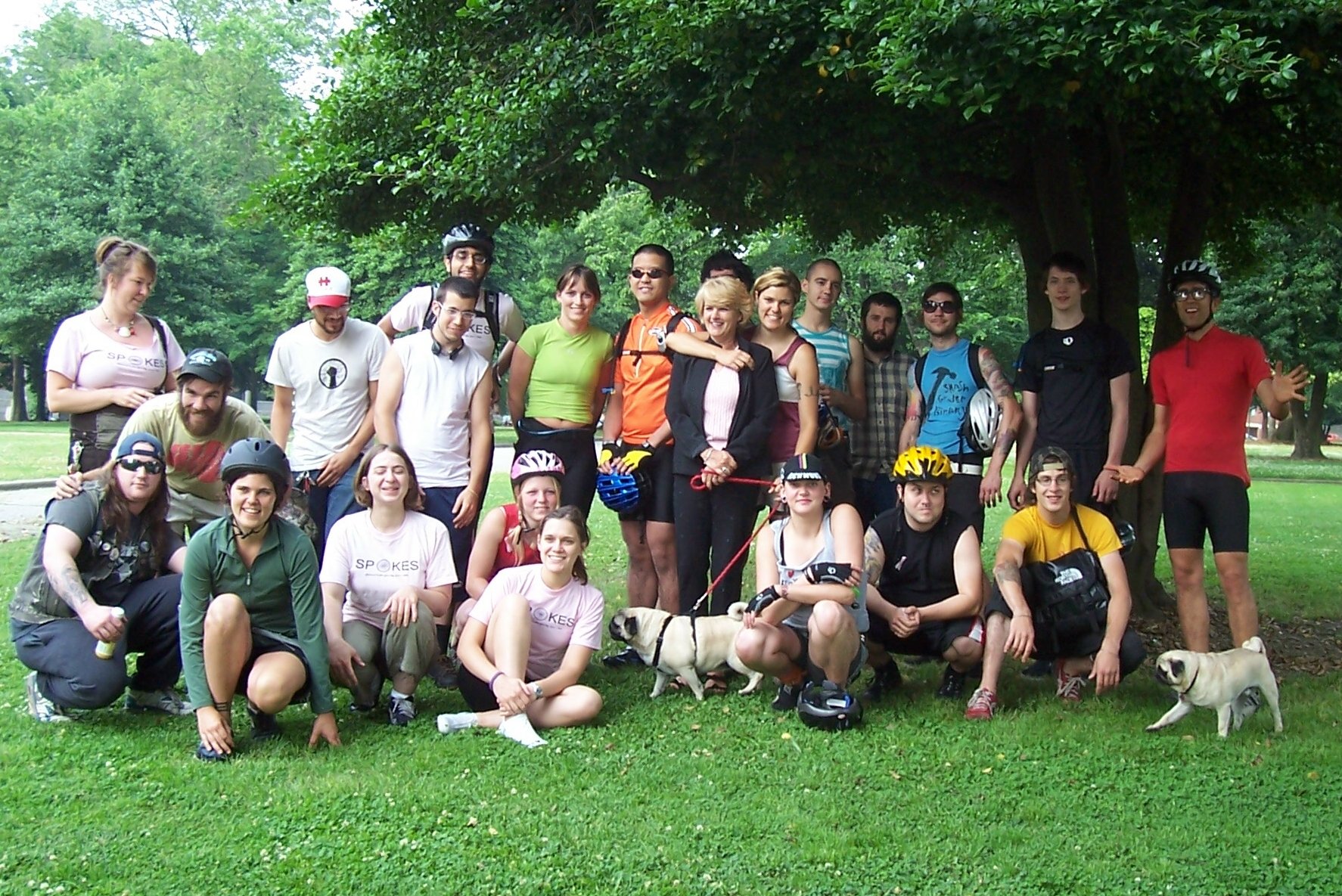
It wasn’t until the morning we left, a Saturday in June, that I looked around and realized just what a motley crew we had. We met in a local park for our official send-off. For most of us, knowing Erin was the only thing we had in common. Some of the team members didn’t even know Erin that well—friends of friends or girlfriends or boyfriends of friends who we had never met before that week. We had riders show up in full spandex with clip-in shoes, and others in cut-off jean shorts and tennis shoes or slip-ons. Riders came on mountain bikes, road bikes, and fixed-gear bikes. Boom boxes were duct-taped to rear racks or placed in baskets on the front of bikes, blasting music from cassette tapes in all directions at 8 a.m. We looked as young and inexperienced and insane as we were to be doing what we were doing. It was awesome. We ate bagels and downed black coffee as we threw our sleeping bags, tents, and book bags into the van, stopping to double-check that we all had full water bottles in our water bottle cages attached to our bikes. The first turn of 25 cranks set us out onto the road, heading north on Route 1, out of town.
It didn’t take us long to find out that the first day of biking was going to be rough. The road conditions were bad, forcing us to ride slowly and pay extra attention to our movements. Gravel shifted under our bike tires, and broken glass and loose rocks meant worrying about popping a tire, or sliding. The shoulder was narrow, and one wrong movement meant losing balance and falling into traffic. I had to concentrate on looking down at the road as much as I could, while at the same time needing to look forward to see what was coming ahead, which was not easy. Vehicles were not exactly nice to us either. A couple of the riders had glass bottles thrown at them, or were yelled at by passengers to get off the road. Traffic was thick, as a steady stream of cars and trucks whizzed by. I could hear each individual vehicle coming, and I tensed up a bit with each gust of wind that hit me as they passed, my grip on my handlebars tightening. The hills that took us through central Virginia seemed endless – how was it possible that they always seemed to go up, but at the top, they never went back down? For hours, we passed gas stations after gas station, endless shopping malls and empty concrete parking lots, the scenery bland and gray. Red lights broke up the group slowly until we were miles and miles apart from one another.
Ahead of us in the van, Anna was also having a rough go of it. She found out quickly that her job was going to be much more difficult than she had anticipated. The separation of the group meant that many hours passed between the first rider coming through the pit stops and the last, making her late for not only the next stop, but leaving her no time for shopping. She had thought she would have hours to leisurely go about her day. Instead, she was being rushed along, leaving her feeling ill-prepared to take care of the team.
By the time we had arrived at our first campsite, a little more than halfway between Richmond and Washington DC., everyone had mixed feelings about the day’s ride. Two people made phone calls home to be picked up that very night—we had made it 60 miles, and they’d had enough. I couldn’t blame them. When everything aches—your neck, your back, your toes, your legs—the last thing you want to contemplate is getting back on your bike again the next day. My fingers and butt had gone numb from riding all day. It was hard to imagine doing it again in twelve hours—and then ten days straight after that. I was somewhere in the middle of feeling defeated and exhilarated. I wasn’t going to quit, but I was in a lot of pain. As I set up my tent, I looked around and saw other riders already sitting by the campfire, relaxing as though they had had the easiest of days on their bikes. After changing out of my spandex and tennis shoes, I joined the group for dinner, and I was pleasantly surprised how much I was able to eat, a welcome realization after how much I had biked that day. I ate everything I could and started to forget about how much my body ached. I downed multiple veggie dogs with ease, chips, and potato salad. I chugged two beers and still felt like I could consume more. It was glorious to eat and drink so recklessly, knowing I was going to go to bed and then burn a ton of calories again with the next day’s ride. Full and sleepy, I unzipped my tent and crawled into my sleeping bag, falling asleep just as soon as my head hit the pillow.
When I woke up the next morning, the sun was shining, and I was sore all over, but I felt incredibly rested, having slept deeply after having pedaled so intensely the day before. I slipped on my spandex, still wet from my sweat, and threw on a pair of jean shorts and a tank top, slipped on my tennis shoes, and left my tent feeling ready to do it all over again. I helped Anna make breakfast, and after we all ate, we packed up our gear and shortly left the campsite.
Our second day of bike riding took us through Alexandria, Virginia, on the serene bike paths and nature trails that lead into the capital. It was Sunday morning, and there was much less traffic than had been on the roads the day before. The smooth black concrete of the path curved only slightly, staying completely flat for the miles we biked into the city, and it was easy for the whole group to bike fast through the wooded area of the park. We passed over wooden bridges and small streams. The sun shone, and the temperature was cool for June. We had all worked hard the day before, and those of us who were still riding were now getting to enjoy the ride, gliding through the day with no cars protesting our presence, our only obstacles the occasional runner or walker on the trail. It seemed like no time had passed when we made it to the other side of the city, ending our day in the backyard of a gracious old friend from Richmond who agreed to let us consume the entirety of her lawn for the night. We laughed and talked well past dark, taking turns telling bad scary stories with a flashlight under our chins, trying to spook one another as though we were little kids. Once again, I slept hard, pleased about how lovely the day had been, thinking little about my aching muscles, numb toes, and sunburnt cheeks.
I woke up the next morning feeling ready for the day. But when I unzipped my tent, I saw that the sky had turned gray and overcast, and it looked as though it was going to rain any second. Just like that, our sunny day biking through the nation’s capital had evaporated. It now felt as though the weight of the world was on us, the form of dark clouds over our heads. I felt glued to my tent. I had been excited before bed the night before to ride, but now the thought of biking for a third day in a row didn’t feel like all that much fun. I struggled to put on my spandex shorts, and the dampness of two days’ worth of sweat made me cringe, my positive attitude shifting drastically.
The rest of the team must have been feeling the same way, because by the time I was dressed, no one else had emerged from their tents, and it seemed we were headed toward a late start. I knew we had a longer day of biking today—we had to make it all the way to Baltimore, which was still another 60 miles—so we needed 9 or 10 hours for the whole group to make it.
I went inside the house to find Erin and Anna in the second-floor kitchen, cooking breakfast for everyone. I told Erin I thought we should announce to get everyone moving. Erin seemed to agree, but when I returned to the kitchen with the megaphone we had brought with us, she brushed it away and turned back to the stove. I had figured since she was in charge, she would be the one to tell the group to get moving, but it seemed she didn’t want responsibility for being the bad guy who interrupted everyone’s slumber. Irritated with her lack of authority, I opened the kitchen window, put the megaphone to my lips, and said in a stern and serious voice, “Riders, it’s time to get up. Pack up your tents and your stuff and get it all in the van immediately. We are leaving in 30 minutes. This is your leader, Erin, signing off.” I knew Erin and I didn’t sound different enough through a megaphone for anyone to think it wasn’t actually her. When I turned around, so pleased with myself, Erin’s face showed a mix of shock and anger. Anna was laughing. I left the kitchen with the megaphone, heading downstairs to put my things in the van.
It did start raining soon after that, just as we got on our bikes, and it didn’t stop raining all day, until we got to Baltimore more than eight hours later. At one point, we stopped to eat in a public park in a small-town square, and I attempted to make rain gear from black trash bags we had in the van. I tore a few open, fitted them around my shoulders and torso, taping the openings around my arms with duct tape. It seemed secure, but within a few minutes of getting back on my bike, the bags started catching in the wind and making a terrible plastic rattling noise that kept me from being able to hear other riders or the cars that were approaching me from behind. And instead of blocking the rain from my body, water still came in through the neck hole. The tape was just trapping rain in instead of allowing it to reflect off of me.
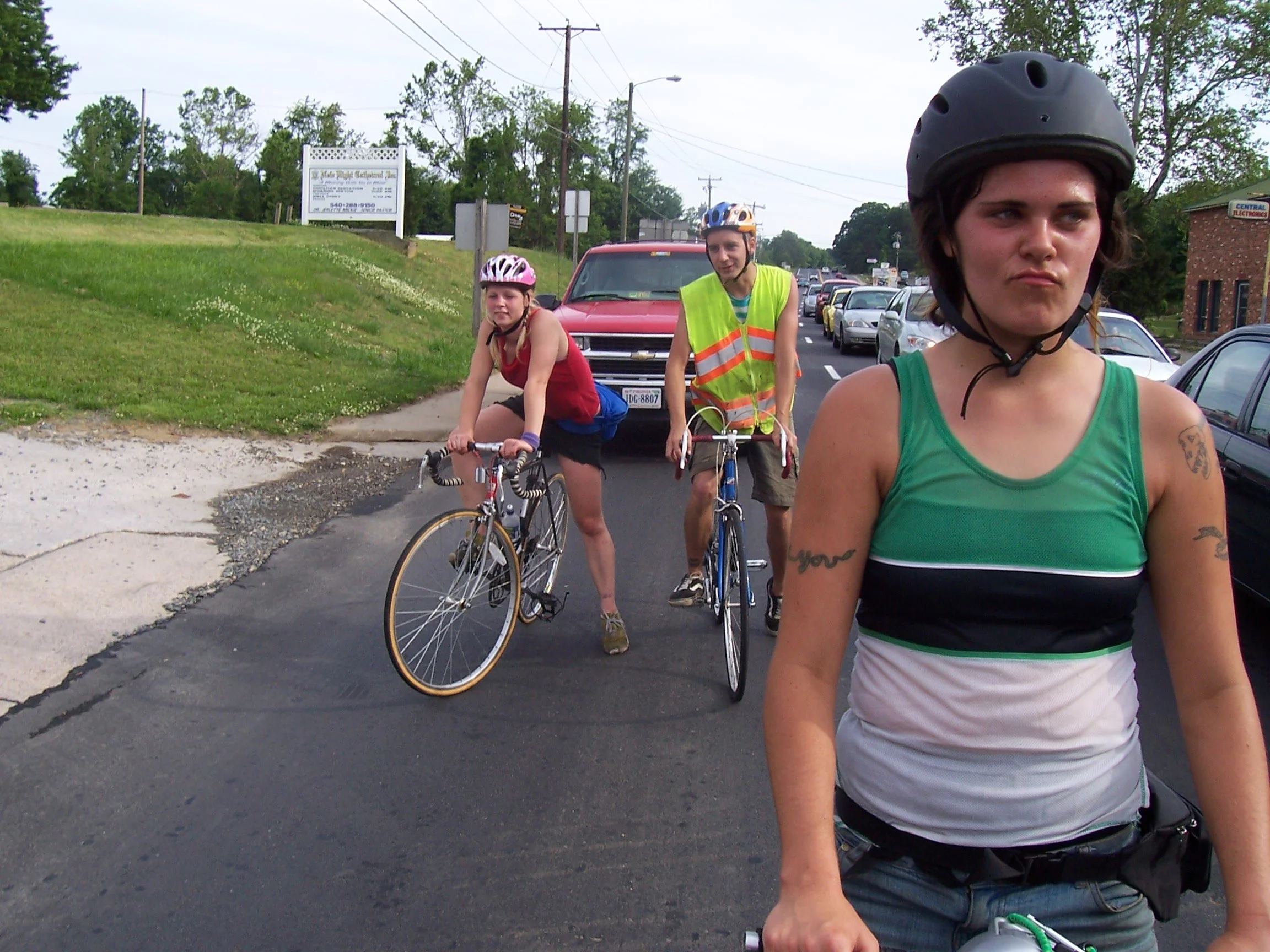
Riding in the rain was relentlessly annoying. The water pounded down on my face, and I couldn’t see where I was going if I looked up, so the only option was to look at the ground, which made the bike ride slow, dangerous, and seemingly endless. At points it felt like I was going backwards because the ground beneath me never seemed to change. My map was soaking wet, ink running down the pages until it was impossible to see the route any longer. I couldn’t listen to music because the water would ruin my boombox, so I had had to leave it in the van for the day. I couldn’t talk to anyone because I would have to shout, and shouting was distracting. When we finally reached the city, we paused, soaking and exhausted, at the railroad tracks for the whole team to catch up. All of us assembled, we got ready to move again, and that’s when we fell; the sound was so precise that riders in the back didn’t realize two people had fallen.
The whole thing only lasted a few seconds, and then it was over, and we were back on our bikes. But my outlook had shifted, not just about the day, but about the whole trip. Right then and there, I wanted to give up, but instead, I finished the day, got some rest again, and did it all over again.
The remainder of the trip went on without much incident. After we left Baltimore, we biked through Pennsylvania, through Amish country, where we saw horse-drawn carriages and rolling green hills, the roads so open we wouldn’t see cars for hours. One night while in Pennsylvania, a bad storm swept through while we were finishing up our ride. We barely made it off the road away from the lightning and thunder to a nearby hotel. The woman behind the desk was kind, letting us bring the bikes we couldn’t fit in the van inside with us and allowing us to sleep five and six people into each room. The next day, we went to a bicycle museum that had bikes from the early 1900s, toy bikes, trick bikes, and bikes made out of wood. We rode along gravel trails that followed railroad tracks. I got a flat tire for the first and only time as I was biking past the Welcome to New Jersey sign.
The night before our last day of biking, we stayed at a campsite in Long Island. The next morning we would cross into New York City over a drawbridge with a bike lane. When everyone got up in the morning, Erin told the group that she had planned this to be a short day of biking. It would only take a few hours to get into the city. She also said she needed one person to ride with Anna in the van. She wasn’t comfortable driving into New York alone—the van had minimal visibility and was full of supplies, and she was worried about changing lanes and making it under low overpasses with the carrier on the roof.
Over the preceding 12 days of riding, there had not been one day when multiple riders had not volunteered to take a day off to ride in the van with Anna. It had never been an issue, even when, on most days, Anna would have been happier having the time alone to herself. I had not been one of those people. I had ridden my bike every day since we had left Richmond. I’d biked every single mile of the trip up to that point, and now that it was the last day and I was only a few miles away from completing the entire trip, I was thrilled by the idea of seeing my hard work pay off. I had not quit. I had not given up. I was going to finish the ride.
After Erin finished briefing us, she asked for a volunteer to ride with Anna. No one raised his or her hand. She asked again. Anyone? No response. I looked around and saw people staring off in other directions or looking at the ground. I started to get agitated. Seriously? No one wanted to take the day off? Interesting that on the last day, on the shortest ride of the whole trip, we had no volunteers for the first time who wanted to take a day off from being on their bike.
After ten seconds of silence, I gave in and volunteered. I was bummed to know I wouldn’t technically complete the ride, but I couldn’t let Anna or my sister down like that. Both of them had done so much to make the trip happen. We were so close to the end where they could finally stop worrying about everyone’s safety, where they could relax and leave behind the roles of the “responsible ones.” All they were asking for was for someone to sit in a van for an hour. I went back to my tent to change out of my spandex and into my jeans. After all the hard work, the intense days of heat and rain and blazing summer sun, I would not come up short of finishing the ride by only 13 miles.
There were no pit stops on the last day since it was such a short ride. The only responsibility Anna and I had was to get into the city and get to the warehouse where we were staying so we could meet the team with their gear. We also needed to be there on time – some of the riders had booked train tickets back to Richmond that afternoon, and would need to grab their belongings out of the van and go as quickly as possible.
It seemed simple enough—we had hours to go a short distance. But just as soon as we crossed the bridge into New York City from Long Island, we were in horrible bumper-to-bumper traffic. We sat in the van, not moving, surrounded on all sides, listening to the impatient sound of honking car horns, unable to see what was causing the holdup. An alternate route was out of the question. We had printed out directions that offered just one option, and our only map in the van was for Virginia, which served us no purpose.
At one point during the gridlock, both Anna and I needed to relieve ourselves so badly that we had to figure out a way to do so in the van. I scrounged in the back and found one of our cooking pots, no longer needed since our trip was coming to an end, and brought it back up to the front, setting it in the passenger seat. There wasn’t enough room to hide in the back and do our business. With the van stopped on the road and windows on all sides of us, we took turns sitting on the pot. It wasn’t flattering, but it was necessary. After we both had a chance to use the pot, I placed the lid on it and set it on the floorboard, holding onto it between my feet so it wouldn’t slide and spill.
Finally, traffic started moving again, although slowly. We relaxed for a few minutes, thinking that maybe the whole day was not going to be stressful after all, until we came to a roundabout, going no more than eight miles an hour, and our turtle top carrier popped open. Every sleeping bag that was inside tumbled out and all over the street, rolling across the road into ditches and bouncing onto the sidewalk. I looked out the side view mirror and saw colorful cotton and vinyl bundles in reds, plaids, blacks, and greens fly through the sky and land on the ground, making no sound as they hit the concrete. I couldn’t believe what I was seeing, my mouth gaping open as I pointed out the window.
Anna pulled over as quickly as she could, and we both jumped out, dodging traffic as we ran around picking up the bags. We could each only hold three bags in our arms at a time and still be able to see over the mass of fluffy, cozy stuffing, and we struggled to gather them all as we yelled at cars to let us pass, screaming at drivers to hold on for just one second while we did a count to make sure we had collected every sleeping bag. We got back in the van and slowly made our way to Brooklyn. By the time we got to the warehouse, we only had about 30 minutes before the riders were to show up. I was tired and mad, and I didn’t care about seeing any one of them. After the day Anna and I had, I didn’t feel like celebrating. I especially didn’t feel like congratulating anyone on finishing a ride that I didn’t get to complete myself. In my exhaustion, both mental and physical, I blamed the other riders for ruining my trip. As the riders started to show up, I found it hard to muster up enthusiasm to give high fives for their successes or feel like I was part of a team anymore. I stayed seated in the van even though it was blisteringly hot. I didn’t want to have to talk to everyone as they arrived and set their bikes down on the sidewalk, drinking water and chatting loudly about how fun the last day of riding had been.
As I sat and sulked, my eyes closed, and my head leaned back against the headrest of the passenger seat, I only thought about how bad I felt for myself. I was broke, and I was far from home. I didn’t really have a job to go back to yet, so I didn’t feel that I had anything to look forward to. I was sick of being around so many people, the same people I’d had so much fun with at a campsite on Long Island the night before, and each day in the two weeks before that. I didn’t care about being there anymore with anyone, not even Anna, who was just as frustrated as I was for the same reasons. I didn’t even think about thanking Anna for all she did to drive our gear and cook for us. I didn’t think about congratulating my sister on spending months planning a trip and safely getting us all to New York. I didn’t think about thanking the other riders for doing something spectacular instead of staying home where life was easier. I didn’t think about how this had been so far one of the best few weeks of my life.
***
I wrote this story in 2017, 12 years after this bike ride took place. Around the same time, from 2004 to 2010, my friends and I would host LOST parties at our houses where we would get together each week to watch episodes of this utterly engaging show, one that we couldn’t stop thinking about and analyzing for the entirety of its six-season run. When the show ended, like many Americans, our group was not just disappointed but upset. We were genuinely hurt by how we felt the writers had wronged us. It was painful and had us angry and easily forgetting the years of excitment leading up to the finale.
When my husband Jim and I started dating in 2011, the LOST parties would come up in nostalgic conversation, he himself having had similar gatherings with his friends. Regardless of how much we would talk about the fondness of these times, I would always come back to how pissed I was about the end of the show. And without a doubt, Jim would say, “But wouldn’t you rather just remember how much fun you had and not how much you hated the ending?”, and I knew he was right. It’s not about the end of the story, its about what happened during the time you were enjoying the story. It is really about whether you had a good time on the journey and if its leaving you with memories that you can cherish for a lifetime.
But that being said…
I’m still real mad about the way LOST ended.